


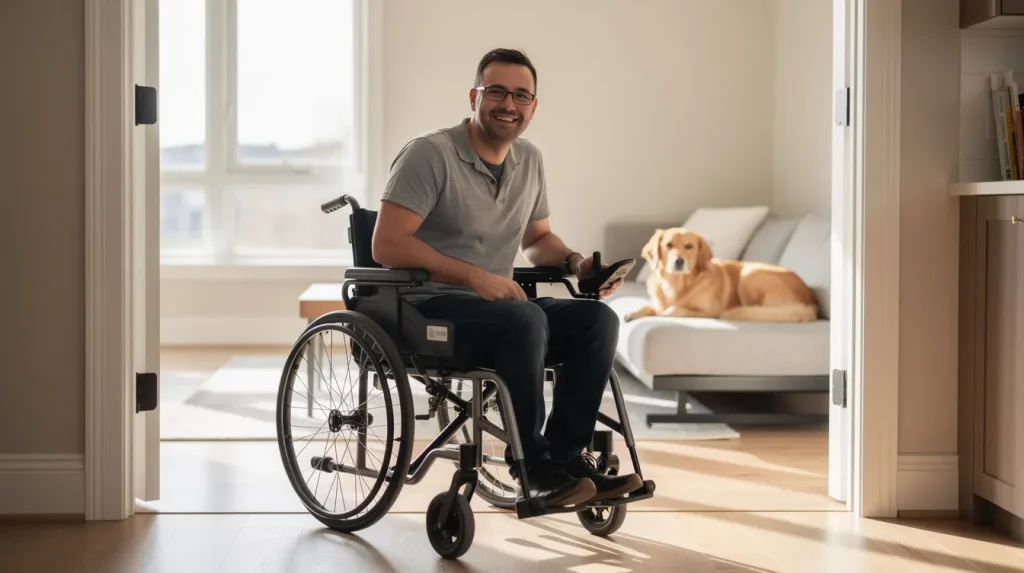
“Welcome home” should never come with an asterisk. Yet for many wheelchair users, home is full of small barriers — a threshold here, a narrow doorway there, a bathroom that demands risky maneuvers. The good news: most homes can be transformed into genuinely accessible spaces, often without a full renovation budget.
This room-by-room guide walks you through the modifications that matter most, from quick weekend fixes to smart long-term investments — so your home works with your wheelchair, not against it.
Start at the Front Door: Entrances and Ramps
Accessibility begins before you’re inside.
- Ramp it right. The gold standard is a 1:12 slope — one inch of rise per twelve inches of ramp length. Steeper ramps are exhausting for manual users and can be unstable for power chairs.
- Choose grippy surfaces. In Canada, ice and snow make traction critical. Textured aluminum or rubber-surfaced ramps outperform smooth wood, and a small roof or awning over the entrance keeps the landing clear in winter.
- Widen the welcome. Entry doors should offer at least 32 inches (81 cm) of clear width — 36 inches is better. Offset “swing-clear” hinges can add almost two inches without replacing the frame.
- Add a landing. A level platform of at least 5 x 5 feet at the door lets you pause, open the door, and enter without rolling backward on a slope.
Doorways, Hallways, and Flooring: The Circulation System
Think of hallways and doorways as your home’s arteries — any narrowing creates daily friction.
- Aim for 36-inch hallways and clear turning circles of at least 60 inches (150 cm) in rooms where you change direction. Power chairs and tilt models need the upper end of that range, so measure against your specific chair.
- Replace thick carpet with low-pile carpet, vinyl, laminate, or hardwood. Deep pile is the treadmill nobody asked for — it drains energy and strains motors.
- Remove or bevel thresholds between rooms; anything over half an inch deserves a mini ramp.
- Consider pocket doors or barn-style sliders where swing doors eat up maneuvering space.
If your home has older, narrower doorframes that simply can’t be widened, the solution can also come from the equipment side: a custom-built wheelchair with a narrower frame tailored to your home’s dimensions often solves what renovation can’t.
The Bathroom: Where Accessibility Pays the Biggest Dividends
No room benefits more from thoughtful design — and no room punishes poor design harder.
- Roll-in shower. Replacing a tub with a curbless, roll-in shower with a handheld showerhead is the single most transformative bathroom upgrade.
- Grab bars everywhere they’re needed — beside the toilet, in the shower, anchored into wall studs or solid blocking, rated for at least 250 lbs.
- Clear floor space. A 60-inch turning circle lets you position for transfers rather than forcing awkward angles.
- Sink access. Wall-mounted or open-underneath sinks let you roll in close; insulate exposed hot-water pipes to prevent leg burns.
- The right equipment completes the room. A well-fitted commode chair bridges the gap between renovation and reality — enabling safe, dignified toileting and showering even while larger modifications are still on the wish list.
The Kitchen: Cooking at Your Height
Independence tastes better when you cook it yourself.
- Lower a section of countertop to 30–34 inches with open knee space beneath for a roll-under workstation.
- Choose a side-opening wall oven and a cooktop with front controls — reaching over hot burners is a burn risk nobody should accept.
- Install pull-out shelves and D-shaped handles; move daily-use items into drawers rather than upper cabinets.
- A side-by-side fridge or bottom-freezer model puts fresh food at seated eye level.
Bedroom and Living Areas: Comfort Without Compromise
- Set bed height to match your wheelchair seat height (typically 19–23 inches) for level, safer transfers.
- Keep a 36-inch clear path around at least one side of the bed — both sides if a caregiver assists.
- Choose furniture with firm, raised seating; deep soft sofas are transfer traps.
- For users who spend long days seated, comfort engineering matters as much as room layout. A tilting wheelchair that redistributes pressure through the day turns any room — living room, home office, TV corner — into a place you can comfortably stay, not just pass through.
Smart Home Technology: The Invisible Modification
Some of the best accessibility upgrades don’t involve a contractor:
- Voice-controlled lights, thermostats, and door locks remove dozens of small daily reaches.
- Video doorbells let you see and speak to visitors before committing to the trip to the door.
- Smart plugs turn lamps and appliances into voice-controlled devices for under $20 each.
- Automatic door openers — long standard in public buildings — are increasingly affordable for home use.
Budgeting and Planning: Do It in Phases
You don’t need to do everything at once. A sensible sequence:
- Phase 1 (low cost, high impact): Clear pathways, threshold ramps, grab bars, furniture rearrangement, smart plugs.
- Phase 2 (moderate): Door hinge swaps, flooring updates, bathroom equipment, entrance ramp.
- Phase 3 (investment): Roll-in shower, kitchen counter modifications, door widening, automatic openers.
Canadian homeowners should also explore funding support: the federal Home Accessibility Tax Credit (HATC), the Multigenerational Home Renovation Tax Credit, and provincial programs can offset a meaningful share of modification costs. An occupational therapist’s home assessment strengthens funding applications and catches issues you might miss.
Your Home, Your Independence
An accessible home isn’t a special home — it’s simply a home that works, for everyone who lives in it. Start with the barriers you bump into daily, fix those first, and build from there.
And if you’re unsure how your equipment and your home can best work together — turning radii, seat heights, custom dimensions — our team has been helping Canadians match wheelchairs to real living spaces since 2002. Reach out through our support page for guidance, parts, and honest advice.
Because at Power Plus Mobility, our slogan isn’t decoration. It’s the goal: Welcome home.
To visit our social media, please click on Facebook and Instagram